What Actually Changed
This week started as a website project and ended as a lesson about coordination.
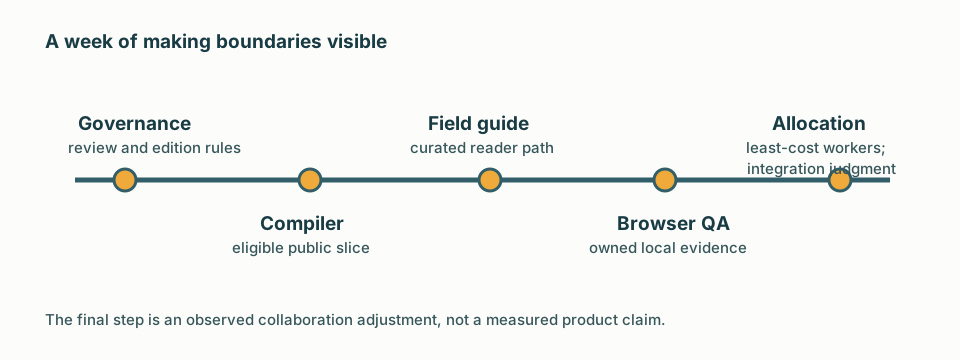
The visible work was straightforward to name. We added publication governance, a compiler, curated internal and public editions, and an isolated way for an agent to inspect rendered interfaces without borrowing a developer's running environment. The less visible change happened in the way the work itself was allocated. I challenged the decision to use Sol Ultra for every worker task. The cost was obvious; the justification was not.
That challenge changed the operating model. Bounded tasks now go to the least-cost model capable of doing them, while the expensive integration judgment stays concentrated where architecture, risk, and editorial coherence have to be reconciled. This is not evidence of measured savings or superior quality. It is an observed correction to the way we coordinate.
And that is the larger point: collaboration has architecture too.
Publication As A Controlled Transition
Before this work, the engineering site had a large source-backed corpus but no strong editorial boundary between “safe enough to consider” and “selected for a public reader.” Those are different states. Treating them as one would be the documentation equivalent of assuming a file is authoritative because it downloaded successfully.
Decision 0005 now makes the transition explicit. Page metadata establishes eligibility. An edition manifest selects the collection. Hosted release approval remains a separate decision. The compiler enforces that sequence and builds the public slice without the repository inventory that supports the internal edition.
Why carry that much state for a static site? Because publication is not a file copy. It is a claim that a specific set of words and visuals has been reviewed for a specific audience. If that decision lives only in someone's memory, the site becomes difficult to operate the moment the collection grows or the original editor is absent.
The public edition is still a preview. Nothing in this work proves a public launch or a production outcome.
Browser QA As Owned Work
The browser problem looked smaller but had the same shape. An agent could, in principle, open whatever local application happened to be running. In practice, that makes the evidence depend on private state: a developer's port, login, database, build cache, and whatever process currently owns the listener.
Decision 0008 replaces that ambiguity with an agent-owned session. The session binds to loopback on a dynamic port, uses a unique build directory and deterministic scenarios, records its process lifecycle, and tears itself down. That makes rendered UX inspection repeatable without pretending the fixture lane proves real authentication, providers, migrations, or production data.
One detail captures why this matters. A 401 is a login state. A permission failure or backend-bootstrap error is not. If the test environment blurs those conditions, a polished sign-in screen can hide the very failure the review is supposed to reveal.
The shortcut would have been to reuse the developer environment. We refused it because convenient evidence that cannot be reproduced is weak evidence.
Validation Pushes Back On The Story
Fast drafting creates a particular kind of temptation: the artifact looks coherent before we know whether it obeys the actual contract. Validation is the part of the system that is allowed to disagree.
The publication checks validate content and visual metadata before a page can enter a public build. The browser lane has focused contract and session-safety tests, followed by inspection of the rendered states it is designed to expose. Neither is universal proof. A successful build shows that content is structurally renderable; it does not show that every public claim is wise. A deterministic browser scenario shows how a state feels and behaves; it does not establish live-provider behavior.
Those limits are not caveats added after the work. They define what the evidence is allowed to mean.
The Allocation Correction
The model-routing issue exposed the same coordination failure in miniature. If every task receives the most expensive model, task boundaries stop carrying useful information. Research, mechanical editing, focused implementation, and cross-cutting integration are treated as though they demand the same kind of judgment. They do not.
The revised pattern separates bounded production from integration. A worker can gather evidence, edit a defined set of files, or run a focused check. The integrator has to review the combined diff, resolve contradictions, inspect the failure paths, and decide whether the evidence supports the claim. I retain the product judgment and the authority over anything external.
This does not mean cheap work is always simple or expensive work is always good. Intake can underestimate risk. Coordination overhead can exceed the value of subdivision. The allocation has to remain revisable as the work reveals itself.
What it does mean is that cost is now part of the architecture instead of an invisible default.
What This Week Proves—And What It Does Not
The shipped facts are narrow: the repository now contains governed publication boundaries, an isolated browser-QA lane, and an explicit least-cost worker allocation pattern. They do not establish a productivity gain, defect-rate improvement, cost reduction, or production reliability result.
The more useful lesson is about where durable systems begin. Whenever a result depends on remembering which page was reviewed, which browser was open, or why a particular model was chosen, the coordination layer is still leaking context. Make that state visible and the work becomes easier to inspect, challenge, and change.
The next notes should test whether this pattern survives harder work: where a bounded worker misses a risk, where integration changes the conclusion, and where validation reveals that the clean story was wrong. That is the evidence worth accumulating.