The Claim
The easy way to describe this work is that I am a solo developer using a coding agent. That description is true, but it is too small. It puts the emphasis on who types the code and misses the harder problem: how intent becomes a durable system without losing context, responsibility, or the ability to repair what goes wrong.
That is the subject of this series. I am building LKCI with Codex in the same repository where the operating rules, implementation, tests, decisions, and recovery procedures live. The interesting question is no longer whether an agent can produce code. It can. The question is whether a fast collaboration can leave behind software that remains understandable after the conversation that produced it is gone.
My working answer is that collaboration needs a coordination layer of its own. Intent has to be made explicit. Evidence has to travel with a claim. Authority has to stay visible. Validation has to push back when the story is cleaner than the implementation. Otherwise speed is mostly a way to create maintenance debt faster.
What The Notes Will Follow
The weekly notes begin with real work: a document that arrived but was not yet safe to publish, a failure that needed to become a repairable work item, a map that had to end in a saved decision, or a browser check that needed its own isolated environment. From there, they widen the frame. What did the problem reveal about the platform? Which shortcut looked attractive? What boundary did we choose instead, and what did that choice cost?
This order matters because architecture is easiest to romanticize when it is separated from consequences. A repository can have elegant packages and still force people to reconstruct reality by hand. A test suite can be green while a user-facing failure is mislabeled. A model can return a plausible answer while the evidence says something narrower. The work itself has to be allowed to correct the abstraction.
Source paths are therefore receipts, not the narrative. A reader should be able to follow the argument without access to the code. A reader with access should be able to check where the argument came from.
What Counts As Evidence
There are four kinds of statement in these notes, and I want to keep them separate.
- A **shipped fact** is supported by a reviewed repository change, test, or durable implementation document.
- A **decision** describes the boundary we intend to preserve, even when the implementation is still catching up to it.
- An **observed working pattern** records how the collaboration actually unfolded without pretending one episode is a benchmark.
- A **lesson** is an interpretation. It may travel beyond the immediate work, but it is not proof.
The distinction is not editorial housekeeping. It is how the series avoids turning a clean explanation into a false claim. Shipping a change does not show that every outcome improved. Writing down a decision does not mean the system fully embodies it. A local browser scenario can reveal a UX failure without proving production behavior. When the evidence stops, the claim should stop with it.
How The Collaboration Works
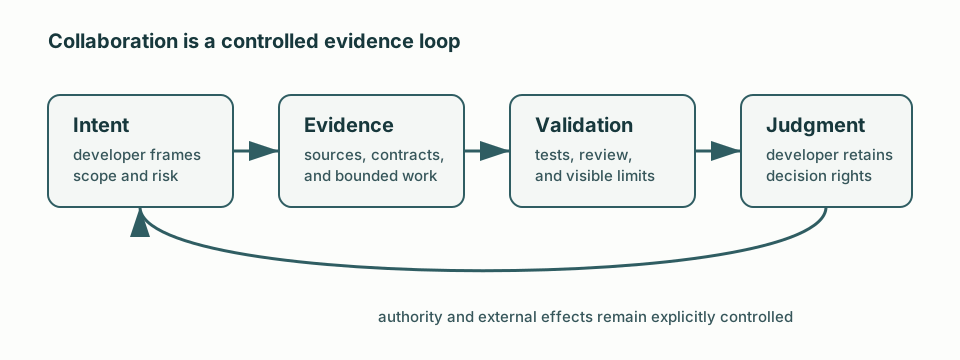
The relationship is a loop, not a handoff. I frame the operating intent and the risk. Codex reads the relevant contracts, source, tests, and prior decisions; it investigates or changes a bounded part of the system. Validation creates new evidence. I retain the judgment about whether the result solves the right problem, respects the boundary, and is ready to affect anything outside the repository.
Different work deserves different allocation. Some changes require sustained reasoning across architecture, safety, and editorial coherence. Others are bounded research, mechanical edits, or focused tests. Using the most expensive model for every task can look like caution while actually hiding a coordination failure. The better pattern is to use the least-cost capable worker and keep integration judgment concentrated where local answers have to become one coherent change.
There are sharp limits. Agents do not gain authority because they can move quickly. Production effects, access changes, external communication, deployment, destructive operations, and Git publication remain explicitly controlled. Agents use the same permission, approval, idempotency, and audit contracts as people and jobs. Capability is not permission.
Privacy Is Part Of The Design
The public field guide is a reviewed slice of the work, not a mirror of the repository. These notes will not publish customer or tenant identifiers, sensitive access material, private URLs, raw operational metrics, confidential incidents, or source artifacts that expose them. They will not invent dialogue, motives, or results to make the story more satisfying.
The byline also needs to be read literally. “Codex” identifies the assistant used in the working process. It does not imply employee status, independent authority, or legal personhood. I retain product, architecture, publication, and external-action judgment. Making the collaboration visible should clarify that structure, not blur it.
What This Can Prove—And What It Cannot
This series is not a productivity benchmark, a security audit, or a claim that one person and a model replace a team. It cannot establish cost savings, defect rates, or production reliability without a measurement method and evidence we can responsibly publish. It does not replace peer review, domain knowledge, or accountability for a deployed system.
The narrower claim is the useful one. When intent, evidence, authority, and validation remain attached to the work, a human-agent collaboration can become inspectable instead of disappearing into chat history. That does not guarantee good software. It creates the conditions under which the software can argue back.
Field Notes
- The Feature Was The Easy Part follows a payroll integration from individually working capabilities to one recoverable operating lifecycle.
- Collaboration Is A System, Too introduces publication governance, isolated browser evidence, and cost-aware work allocation.