Summary
Files arrive before meaning does.
A portal download tells us that a file existed at a source at a particular moment. It does not tell us whether that file is current, relevant, complete, or authoritative for the work ahead. In preconstruction, collapsing those two facts creates a subtle failure: downstream work begins from a document that is available but has never earned the right to shape the project record.
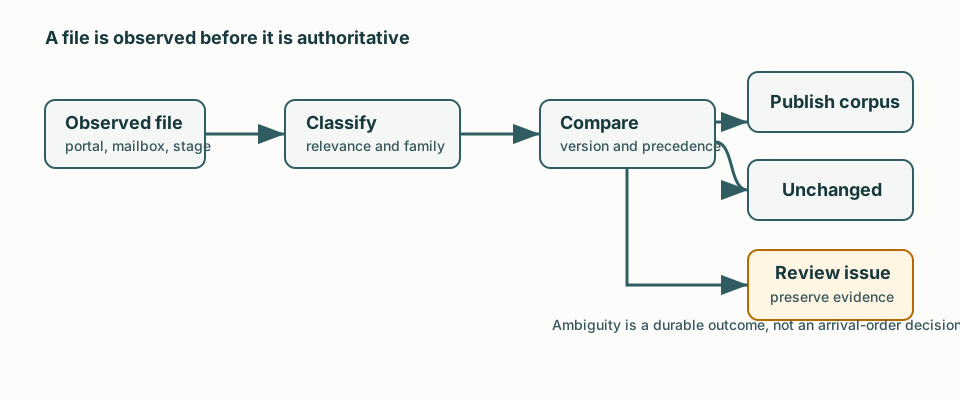
We built publication as a separate, governed decision. Candidate files are observed, classified, compared, and assigned to a document family. Where the evidence is sufficient, precedence policy determines what becomes current. Where it is not, the uncertainty becomes review work. Provenance survives either way.
The distinction sounds procedural. It is actually about organizational memory: whether the next estimator inherits a decision with evidence, or a folder full of files and the burden of reconstructing what happened.
Operational Tension
Portal, mailbox, and staged-file sources produce the normal disorder of real work: duplicates, revisions, unchanged files, incomplete packages, and documents whose role is unclear. A pipeline can transfer every byte correctly and still leave the business question untouched. Which file belongs in the opportunity corpus? Which revision should inform sizing or an RFI? What happens when two plausible sources disagree?
If every download is treated as published, each consumer must answer those questions again. The estimator, sizing workflow, and RFI process can reach different conclusions from the same evidence, and the reasoning disappears between handoffs. If every file is routed to a person, the system preserves caution but turns ordinary processing into clerical review.
The constraint is not transfer speed. It is the cost of translating an untidy external artifact into shared, defensible operational state.
Decision: Publish A Governed Corpus
Observation, storage, and publication are separate states. Storage preserves the artifact. Publication services determine relevance, resolve semantic families, compare candidates, apply precedence, and write versioned, opportunity-owned document state. Downstream work begins from that state, not from the incidental contents of a directory.
Precedence is where transport becomes policy. Candidates are compared using domain characteristics such as family, freshness, scope, classification, and evidence quality. The point is not to claim a universal algorithm for document truth. It is to make this domain's judgment visible enough to test, explain, and revise. A candidate can become current, remain unchanged, require reclassification, or produce a review issue.
That leaves us with a deliberately narrow definition: publication means the system has created a controlled internal record with provenance and a declared relationship to its source. It does not mean the document is complete, correct for every use, or immune to supersession.
Failure And Repair Posture
Ambiguity is not a reason to guess. When the service cannot resolve family or precedence safely, it does not fall back to arrival order, overwrite a current record, or leave the next consumer to infer what happened. It records a reviewable issue and carries the relevant evidence forward.
The human contribution is judgment, not reconstruction. A reviewer should see the candidates and the unresolved relationship, make the classification or precedence choice, and update durable workflow state. Indexing, sizing, RFI context, and estimator review can then share the result. The next run compares against remembered state instead of reopening a pile of files.
Expected ambiguity remains distinct from a broken program or failed authority check. A malformed policy, authorization failure, or violated invariant must fail visibly. A plausible but unresolved document relationship is work to be decided. Hiding both behind the same catch would erase the very distinction repair depends on.
Tradeoff
Publication adds policy, durable state, and sometimes a review step. A document may reach a downstream process later than it would through a direct download-to-index path. Precedence rules need tests. Provenance must survive. Unchanged and superseded outcomes have to be modeled explicitly.
The shortcut does not remove that cost; it distributes it. Every estimator and workflow must improvise an answer to "which file counts?" The system looks fast until the first conflicting revision, then pays through repeated interpretation and inconsistent action. We chose to put that cost at one visible boundary so later work can proceed from the same corpus.
Limits
This proves that an artifact can enter an operational system without silently becoming authoritative. It does not prove that the external source is complete or truthful, nor does it replace judgment about plans, scope, or bid strategy. The pattern should not become one global publication table for unrelated workflows; document meaning remains domain-owned. This public account also omits source-specific examples, customer context, and operational counts.
Transferable Lesson
When an external artifact can shape later action, separate "we received it" from "the system may rely on it." Preserve the criteria and provenance, make uncertainty repairable, and let consumers inherit the decision instead of inventing their own authority. The same principle applies to files, imported records, model-extracted evidence, and analytical datasets.